

Patient Info
Age:
40-49
Ethnicity:
White
Height:
5’ 0” - 5’ 5”
Weight
100 - 149 lbs
Ready to see what's possible for you?
Schedule your personal consultation with Dr. Shamoun today and take the first step toward looking as vibrant as you feel.
Book An Appointment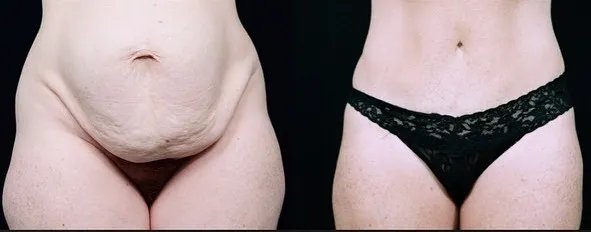
Front View
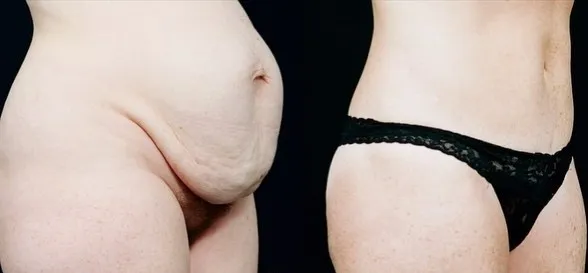
Side View
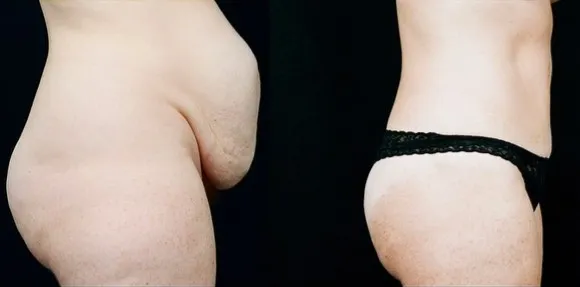
Profile View
Abdominoplasty
My Approach
This 40 year old female presented after multiple pregnancies and weight gain with significant abdominal laxity, separation of the rectus muscles, and a large ventral hernia that distorted the contour of her torso. Beyond excess skin, there was true structural weakness of the abdominal wall and loss of the natural feminine waistline. In cases like this, simply removing skin is never enough. A successful abdominoplasty must restore anatomy first and aesthetics second. Tightening the muscles, correcting hernias, and reshaping the waist are just as important as excising loose tissue. She underwent a full high lateral tension abdominoplasty, often referred to as a French style pattern, combined with ventral hernia repair, diastasis muscle reconstruction, and selective liposuction for contour refinement. This technique allows tightening both vertically and horizontally, sculpting the waist and hips rather than creating a flat or boxy abdomen. Great abdominoplasty results are determined by small details. The location of the scar, the symmetry of the closure, the smoothness of the contour transitions, and a natural looking umbilicus all separate an excellent result from an average one. The abdomen should never look over pulled or artificial. A woman’s body should maintain curves, a defined waist, and a gentle S shape in profile.

Dr. John Shamoun
MD FACS
The Healing Process
Recovery after abdominoplasty is typically straightforward when surgery is carefully planned and executed with meticulous technique. Most patients walk the same day of surgery and are encouraged to stay mobile to promote circulation and healing. During the first two weeks, there is tightness, swelling, and mild discomfort similar to an intense workout. A compression garment is worn to reduce swelling and support the repair. Light daily activities can be resumed quickly. By weeks three to six, swelling continues to decrease and posture improves as the muscles relax. Most patients return to work and light exercise during this time. By two to three months, normal workouts and full activity are usually resumed. Scars gradually soften and fade over six to twelve months. Final contour and refinement continue to improve throughout the first year. Muscle repair also often leads to better posture, improved core stability, and relief of back discomfort.
FAQs
Abdominoplasty, or tummy tuck surgery, removes excess skin and fat while tightening the abdominal muscles. Ideal candidates are patients with loose skin, muscle separation, or hernias that cannot be corrected with diet or exercise alone, especially after pregnancy or weight loss.
Yes. In most patients, the rectus muscles are separated, a condition called diastasis. Repairing these muscles restores core strength, flattens the abdomen, improves posture, and can even reduce back pain. This step is critical for a long lasting result.
Often it is. Liposuction helps refine the surrounding areas such as the flanks and hips to create smooth transitions. Without contouring these adjacent regions, the abdomen can look tight but disproportionate.
The scar is placed low on the abdomen, typically hidden within underwear or swimwear. With proper closure and healing, it fades significantly over time. Careful planning ensures the scar is symmetric and discreet.
Most patients describe the discomfort as tightness rather than sharp pain. Walking begins immediately, daily activities resume within one to two weeks, and most people feel close to normal by four to six weeks.
Yes. The skin removal and muscle repair are permanent structural changes. Results are long lasting as long as weight remains stable and future pregnancies are avoided.